
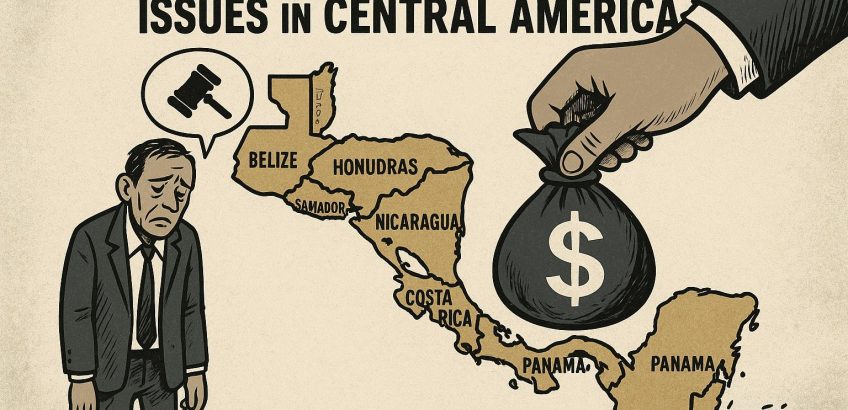
Corruption and governance issues in Central America
Introduction
Central America, teeming with cultural diversity and abundant natural resources, is a region that faces continuous challenges in achieving political stability and sound governance. At the heart of these challenges is corruption, a pervasive issue that deeply affects the political climate. It not only impedes economic development but also disrupts social justice systems. This article explores the multifaceted nature of corruption and governance within Central America, emphasizing recent developments and their potential implications for the future of the region.
Understanding Corruption in Central America
Corruption is endemic in Central America, entrenched at various levels of government and society. It is not a monolithic issue but presents itself in numerous forms, including bribery, embezzlement, nepotism, and electoral fraud. These corrupt practices cripple the efficient delivery of public services and undermine the rule of law, presenting formidable barriers to overall progress.
Factors Contributing to Corruption
A combination of factors has contributed to the persistent corruption seen in the region. Historically weak institutional frameworks, lacking robust checks and balances, have allowed such practices to flourish unchecked. The concept of political patronage further exacerbates this environment. Here, power is distributed based on loyalty rather than merit, creating a network where the powerful elite reign supreme. This dynamic inevitably leads to restricted accountability, as those with power protect each other’s interests.
Case Studies
Recent scandals have highlighted the corruption that plagues various countries within Central America. A notable instance is in Guatemala, where former President Otto Pérez Molina, along with his vice president, became embroiled in a notorious customs corruption scheme called “La Línea.” This case did more than just reveal the depth and breadth of corrupt practices; it ignited nationwide protests calling for political reform.
In Honduras, the government has been riddled with allegations of misusing public funds. There are also troubling revelations about links to drug trafficking cartels. These incidents vividly illustrate the complex and often dangerous entanglement between organized crime and political entities across Central America.
Impact on Governance
The impact of corruption on governance in Central America is profound. It erodes the public’s trust in government institutions, a situation that has far-reaching consequences. Without trust, foreign investments are deterred, stifling economic growth and perpetuating existing cycles of poverty and inequality. Furthermore, when corruption diverts resources away from their intended purposes, crucial sectors such as education and healthcare suffer, leaving the general population underserved.
Efforts to Combat Corruption
In response to these challenges, numerous initiatives have been established to tackle corruption in Central America. International organizations, working in tandem with local governments, have rolled out programs designed to enhance transparency and promote accountability. A landmark effort was the creation of the International Commission against Impunity in Guatemala (CICIG). Although it was dissolved in 2019, CICIG set an important precedent for future anti-corruption initiatives in the region, providing a valuable lesson in the importance of international support and collaboration.
Role of Civil Society
Civil society plays an indispensable role in the fight against corruption. Grassroots movements, protests, and advocacy groups continue to exert pressure on governments to implement essential reforms. The advent and proliferation of digital technology have further empowered citizens. They can now document and disseminate instances of corruption more effectively, raising public awareness and holding officials to account more rigorously.
The Path Forward
For Central America to embark on a constructive path forward, it will require sustained commitment from both domestic and international actors. Key steps include strengthening institutional frameworks, enforcing existing laws, and cultivating a culture of transparency and integrity. Collaboration between governments, nongovernmental organizations, and international bodies is crucial. This united front could significantly enhance governance, paving the way for a stable and prosperous region.
The importance of addressing corruption in Central America cannot be overstated, as it represents a fundamental barrier to the region’s sustainable development. While substantial challenges remain, ongoing efforts signal a commitment to change and hope for the future. For individuals interested in exploring the intricate relationship between governance and corruption further, resources provided by organizations such as Transparency International and United Nations Development Programme offer an excellent starting point for deeper investigation and understanding.
Conclusion
In conclusion, tackling the entrenched corruption in Central America is not just a goal but a necessity for the region to realize its full potential. It impacts every facet of life — from the integrity of political processes to the effectiveness of economic policies and the equity of social justice systems. While the road to reform is riddled with obstacles, the collective commitment witnessed in recent years signifies a positive trend that could redefine the future of Central America. Moving forward, continued diligence and collaboration among all stakeholders will be imperative. Their concerted efforts can establish more robust governance frameworks and cultivate an environment where transparency, fairness, and accountability are not just ideals but realities.